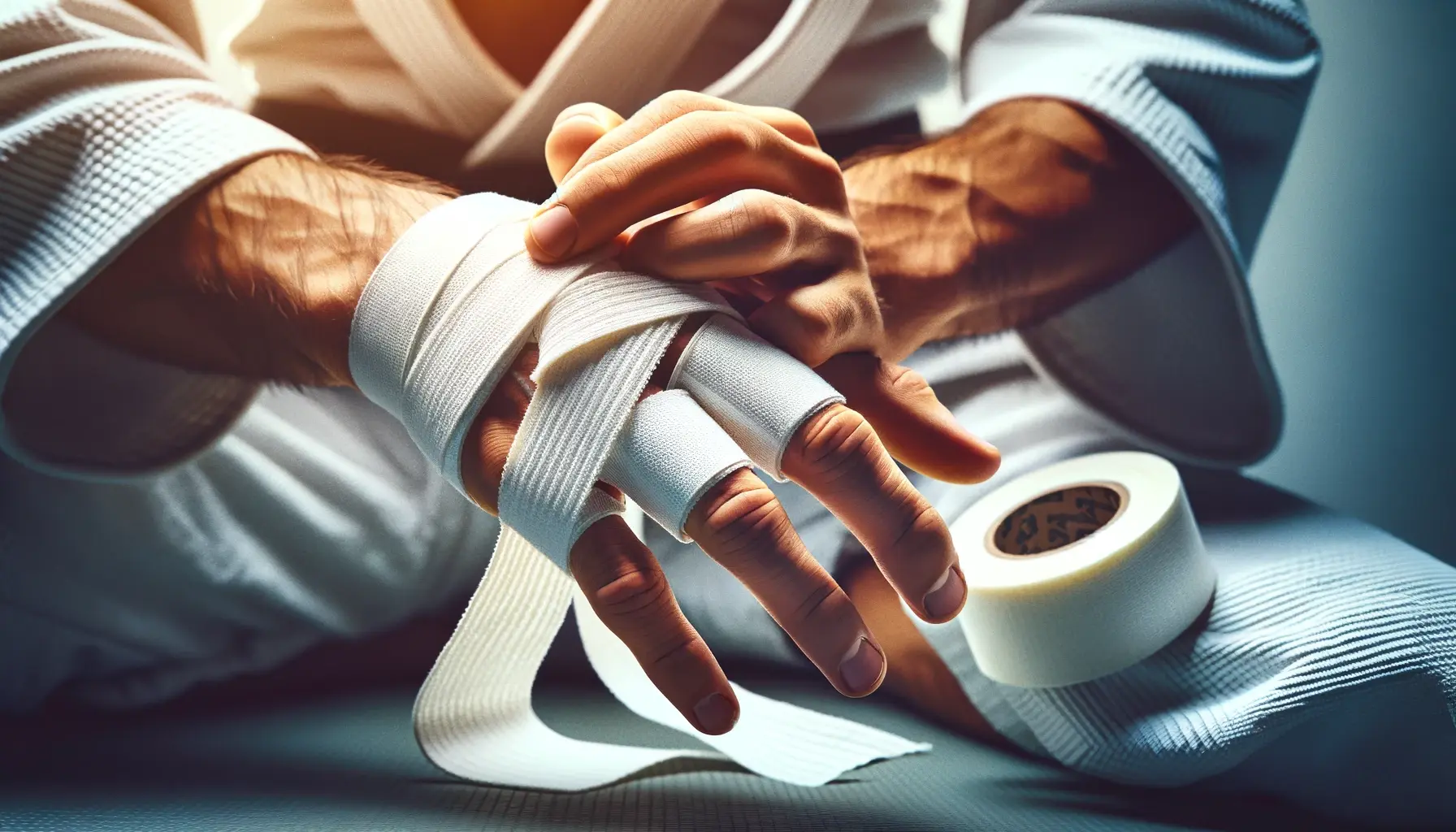
BJJ Finger Tape: How to Use It and Why It Matters
Complete guide to BJJ finger tape: why grapplers use it, how to wrap (X-tape, buddy tape, circular), what to buy, and how to remove it without ripping skin.
If you have trained BJJ for any length of time, you have seen black belts wrap their fingers before class and wondered whether you should be doing the same. The answer for most regular grapplers is yes. Finger tape protects sprained and overworked joints, supports stronger gi grips, and extends a training career that would otherwise be cut short by chronic hand injuries.
This is the practical guide: why to tape, what to buy, how to wrap, and how to remove it without tearing your skin off.
Quick start
- What it is: Thin (0.3 to 0.5 inch wide), strong, slightly stretchy adhesive tape designed for finger joints.
- Why grapplers use it: Prevent sprains, stabilise injured fingers, support grip strength on the gi.
- What to buy: Cotton-based or cotton-synthetic blend, hypoallergenic adhesive, 0.3 to 0.5 inch width. Avoid generic medical tape; it does not hold up.
- How to wrap: The X-tape is the standard. Buddy tape if a finger is injured. Circular wraps for general support.
- How long it lasts: One wrap usually survives a full training session. Sweat and friction reduce the life of even premium tapes.
Why BJJ destroys your fingers
BJJ puts unusual stress on the fingers. The gi grip game forces your hands to:
- Grip and tug on stiff gi lapels, sleeves and pants for hours per week
- Resist the opponent stripping your grip, often by twisting and yanking your fingers
- Recover from forced extensions when your hand is caught in a transition
- Train through small sprains and strains that never fully heal between sessions
The cumulative result is well-known among older BJJ practitioners: chronic finger pain, "cauliflower knuckles", swelling that lasts for days after training, and a generally beaten-up look to the hands. Finger tape reduces all of it.
What BJJ finger tape actually does
Three functions:
1. Injury prevention
Tape restricts excessive joint movement and resists the forces that cause hyperextensions and twists. A correctly taped joint stays in its safe range of motion. Beginners benefit from preventative taping during heavy gripping sessions. Veterans benefit from taping joints that have a history of problems.
2. Injury management
If you already have a sprained or overworked finger, tape keeps it stable enough to train without making it worse. The brace-like effect lets the joint move within a controlled range. Many BJJ practitioners train through small injuries that would otherwise need weeks off.
3. Grip support
Tape binds adjacent fingers together so they work as a unit. The result is a stronger grip on the gi that holds better through scrambles, and is harder for the opponent to break.
What to look for in BJJ finger tape
A good BJJ finger tape has:
- Cotton or cotton-synthetic base. Pure synthetic is too stretchy; pure cotton is too stiff. The blend gives you both support and movement.
- Width of 0.3 to 0.5 inch (around 7 to 13 mm). Narrow enough to wrap individual fingers, wide enough to provide support.
- Strong, moisture-resistant adhesive. Cheap adhesives slip the moment you start sweating.
- Hypoallergenic adhesive. Reduces skin irritation, especially important if you tape frequently.
- Serrated edges. Lets you tear by hand without scissors.
- Some stretch. Enough to follow the joint through its safe range of motion, not so much that it loses support.
Zinc oxide tapes (with zinc oxide infused into the adhesive) offer additional anti-inflammatory benefits and are worth the slight extra cost if you tape often.
How to wrap your fingers: four methods
1. X-tape (the default)
The X-tape stabilises a specific joint while leaving the rest of the finger free to move. The most common BJJ finger taping technique.
How to do it:
- Cut a piece of tape 4 to 6 inches long.
- Start below the joint. Wrap once around the base of the finger to anchor.
- Cross over the joint diagonally toward one side.
- Bring it back down the opposite side, forming an X over the back of the joint.
- Anchor below the joint on the other side with a final wrap.
- Check the tightness. You should bend the finger comfortably. No numbness or colour change.
The X-tape works for sprained PIP joints (the middle finger joint), which is the most commonly injured area in BJJ.
2. Buddy tape
Tape the injured finger to an adjacent healthy finger so they move as a unit. The healthy finger acts as a splint.
How to do it:
- Wrap once around both fingers above the injured joint.
- Wrap once around both fingers below the joint.
- Leave the joint itself unwrapped so it can still bend slightly.
Buddy tape is the move for badly sprained fingers, especially if you need to keep training. It is also useful for hyperextended PIP joints recovering from a recent injury.
3. Circular wrapping
A simple wrap around the entire finger or joint for general support. Less targeted than the X-tape but quicker to apply.
How to do it:
- Wrap the tape around the joint area, overlapping each layer by about a third.
- Stop after two or three wraps. More than that restricts blood flow.
Good for general grip support during a training session. Not ideal for specific injury management.
4. Joint-specific support
Tape above and below the joint, leaving the joint itself completely free. Useful when you want to protect the tendons around a joint without restricting its movement.
How to do it:
- Wrap once above the joint.
- Wrap once below the joint.
- Leave the joint itself unwrapped.
The least restrictive option. Suits prophylactic taping when nothing is acutely injured.
Common mistakes when taping
The mistakes that turn finger tape into a problem:
Overwrapping
More tape is not more support. Two to three layers is plenty. More than that restricts blood flow and reduces mobility for no extra benefit.
Taping too tight
The tape should feel snug, not constrictive. If your finger goes pale, tingles, or feels cold within a few minutes, the tape is too tight. Remove and re-apply looser.
Not preparing the skin
Wash and dry your hands before taping. Tape on damp or oily skin slips off within minutes. Avoid lotions on the fingers before training.
Skipping breaks
If you tape every training session for years, the skin underneath needs occasional recovery time. Skin irritation, adhesive allergies, and even small infections come from constant taping with no breaks.
Wrong tape
Generic medical tape does not work for BJJ. It is too sticky, too rigid, and rips skin on removal. Use BJJ-specific or athletic-specific tape.
Not adjusting mid-session
After 30 to 45 minutes of training, sweat and friction loosen most tapes. Check between rounds and re-wrap if needed.
How to remove BJJ finger tape without tearing your skin
If you have ever ripped off a tape and lost a layer of skin with it, the protocol below will save you a lot of pain.
1. Loosen the tape first
Gently massage the taped area to break the adhesive bond before peeling.
2. Peel slowly
Start at one end. Peel slowly, watching for resistance. If the tape pulls hard, stop and try a different angle.
3. Peel in the direction of hair growth
If you peel against the hair, you will rip it out. Move with the hair direction, not against it.
4. Use oil if it is stuck
A drop of baby oil, coconut oil or olive oil on the edge will dissolve the adhesive. Wait 30 seconds and peel.
5. Wash after removal
Soap and water to remove adhesive residue. Then dry thoroughly.
6. Check for irritation
Redness or rash after taping is a sign the adhesive is too strong for your skin or you left the tape on too long. Switch to a hypoallergenic option.
How much tape do you actually need?
A rough working estimate:
- Beginners (1 to 2 sessions a week): One 10 m roll lasts 2 to 3 months.
- Regular (3 to 4 sessions a week): One 10 m roll per month.
- Competition track (5+ sessions a week): Two or more rolls per month.
Buy in multi-packs if you train regularly. The price-per-roll drops significantly with bulk options.
When not to tape
Tape is not a substitute for proper recovery. Skip taping and rest if you have:
- Acute injury within 24 hours. Ice and rest first; consider taping once the swelling is down.
- Open wound at the taping site. Cover and heal first.
- Confirmed broken finger. See a doctor; tape will not stabilise a fracture.
- Persistent numbness or skin irritation from previous taping.
If a finger has been sore for more than 4 weeks, see a doctor before continuing to train through it. Some BJJ finger injuries need surgical correction if left too long.
Frequently asked questions
Why do BJJ players tape their fingers? To prevent finger sprains, stabilise existing injuries, and support gi-grip strength. Finger tape extends training careers that would otherwise suffer from chronic hand injuries.
What is the best BJJ finger tape? Look for cotton or cotton-synthetic blend tape, 0.3 to 0.5 inch wide, with hypoallergenic adhesive and serrated edges. BJJ-specific brands and athletic tapes both work. Avoid generic medical tape.
How do you tape your fingers for BJJ? The X-tape is the standard: anchor below the joint, cross diagonally over the back of the joint, anchor on the other side, forming an X over the joint. Buddy tape (taping an injured finger to a healthy one) is the move for more serious injuries.
How often should I tape my fingers? Tape only when you need it. Heavy gripping sessions, recovering from an injury, or specific joints with a history of problems. Daily taping for years without breaks can cause skin issues.
Does BJJ finger tape really work? Yes. The combination of joint stabilisation, grip support and proprioceptive feedback is well-established for both injury prevention and management. Most experienced BJJ practitioners tape regularly.
Can I reuse finger tape? No. Once removed, the adhesive is shot. Each wrap is single-use.
Is BJJ finger tape the same as athletic tape? There is overlap. Athletic tape works for BJJ, but BJJ-specific finger tape is usually narrower (0.3 to 0.5 inch) and designed for moisture and friction resistance. Athletic tape is wider and intended for ankles and larger joints.
Can I train BJJ with broken fingers? No. Broken fingers need a doctor. Tape will not stabilise a fracture, and training through one usually makes it worse.
Does tape get loose during training? Yes. Sweat and friction loosen most tapes after 30 to 45 minutes. Check between rounds and re-wrap if needed. Higher-quality adhesives last longer.
How do I remove finger tape without losing skin? Massage the area to loosen the adhesive, peel slowly in the direction of hair growth, and use a drop of oil if the tape is stuck. Wash the skin afterwards.
The bottom line
BJJ finger tape is one of the cheapest pieces of grappling gear and one of the highest-leverage for long-term hand health. A few dollars of tape per month protects fingers worth far more than that.
Buy a multi-pack of BJJ-specific or athletic tape in the 0.3 to 0.5 inch range. Learn the X-tape and buddy-tape methods. Tape only when you need to, remove carefully, and let your skin recover between heavy taping sessions.
For more on training gear, see our BJJ gear guide, best BJJ gis and best BJJ rashguards. For more on grip training (the longer-term answer to finger problems), see our Daniel Strauss profile.
Follow us on TikTok.
Last updated May 16, 2026
Filed under Gear Reviews
// Keep going
More from Gear Reviews
Top 5 BJJ Gis on Amazon (Honest Picks)
The best BJJ gis you can buy on Amazon: Vector, Elite Sports, Sanabul, Tatami Initial and Venum Contender. Specs, fit, price and who each one is best for.

Hayabusa Rashguard Review: Long-Term Use for BJJ
Honest long-term review of the Hayabusa rashguard for BJJ: build quality, fit, durability over a year, washing routine, pros and cons, and who it suits.
Hayabusa Ultra-Lightweight Pearlweave Gi Review
Honest long-term review of the Hayabusa Ultra-Lightweight Pearlweave BJJ gi: 350 GSM pearl weave jacket, 8oz ripstop pants, fit, durability, washing routine and verdict.