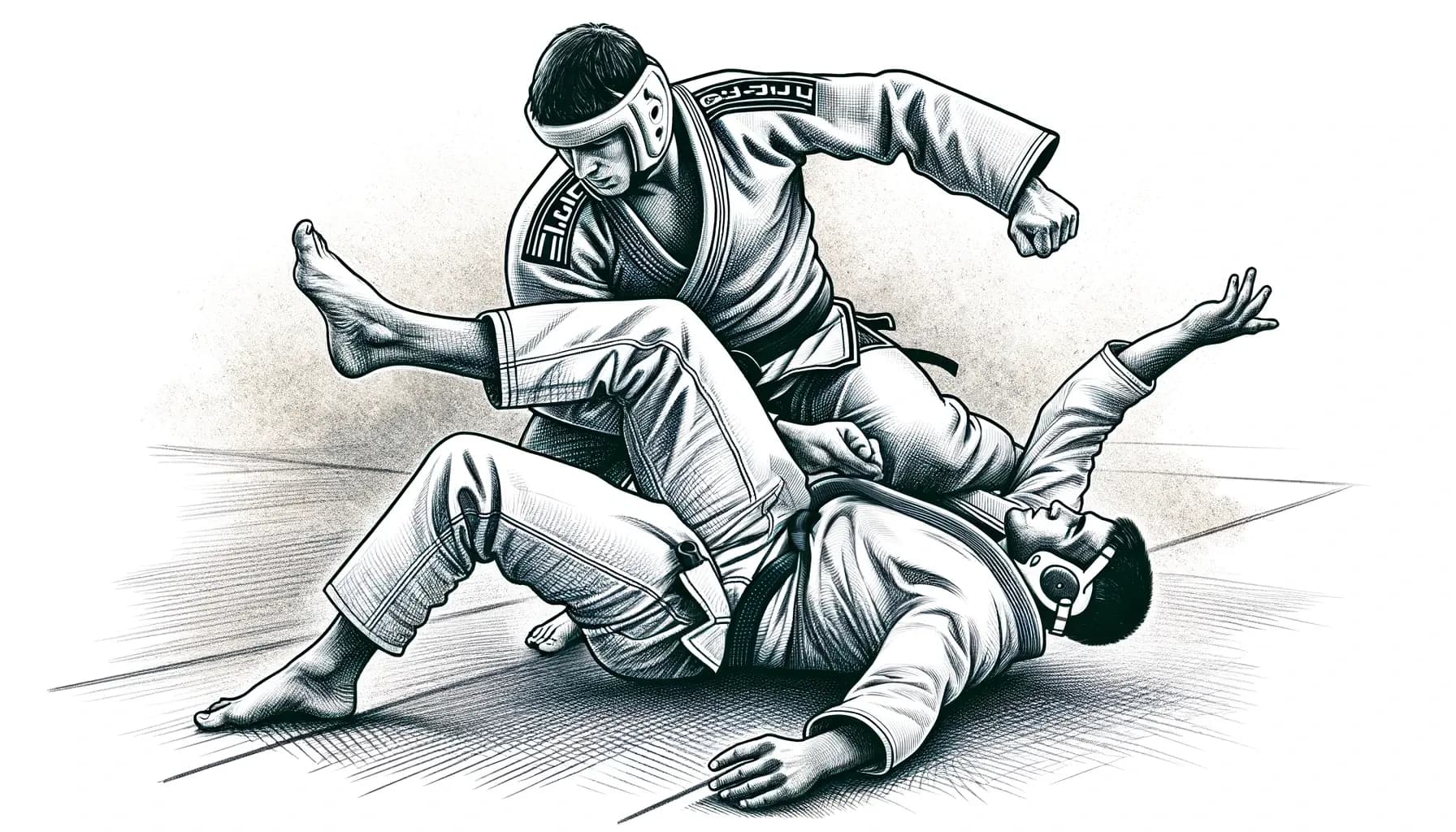
BJJ vs Wrestling: Differences, Strengths and Which to Train
BJJ vs wrestling: side-by-side comparison of techniques, strategy, fitness demands, MMA application, and a clear answer to which is best for self-defence and competition.
BJJ and wrestling are the two most influential grappling arts in modern combat sports, and the debate over which is better is constant in gyms, MMA forums and online comment sections. The honest answer: they are different tools, and the right one depends on what you want from training. This is the working comparison.
BJJ vs wrestling at a glance
| Aspect | BJJ | Wrestling |
|---|---|---|
| Primary goal | Submission (chokes and joint locks) | Pin (shoulders on the mat) or scoring control |
| Range | Ground-focused | Standing into ground |
| Tempo | Patient, position-first | Explosive, takedown-first |
| Win condition | Tap-out or points | Pin or points |
| Fitness emphasis | Aerobic endurance, flexibility | Anaerobic power, explosive strength |
| Olympic sport | No | Yes (freestyle and Greco-Roman) |
| Self-defence | Strong on the ground, weaker standing | Strong takedowns, weaker submissions |
| MMA value | Submission threats, guard play | Takedowns, top control |
| Average time to proficiency | Long (10+ years to black belt) | Long (4-year college programmes are standard) |
| Injury profile | Joints, fingers, neck | Cauliflower ear, knees, neck |
What BJJ actually is
Brazilian Jiu-Jitsu is a ground-focused submission grappling art. The win conditions are:
- Submission: Tap from a choke or joint lock.
- Points: Awarded for established positional control (mount, side control, back, etc.)
BJJ comes from Japanese Jujutsu and Kodokan Judo, brought to Brazil by Mitsuyo Maeda in the early 20th century and refined by the Gracie family. The modern sport is centred around IBJJF competitions in gi and no-gi, plus ADCC for elite submission grappling. See our What is ADCC explainer and our BJJ moves glossary for the technical foundation.
What wrestling actually is
Wrestling is a standing-into-ground combat sport focused on takedowns, control and pins. It is one of the oldest organised sports in human history, with depictions dating back 15,000 years and a continuous Olympic presence in two formats:
- Freestyle wrestling: Both upper and lower body holds allowed.
- Greco-Roman wrestling: Upper body only; no leg attacks.
A wrestling match is won by pinning the opponent's shoulders to the mat (instant win) or by accumulating points through takedowns, escapes, reversals and exposing the back.
Techniques: where they differ
BJJ core techniques
- Submissions: Rear naked choke, triangle, armbar, kimura, americana, omoplata, heel hooks (no-gi). See the BJJ submissions section in our glossary for the full set.
- Guards: Closed guard, open guard, butterfly, spider, De La Riva, half guard. BJJ practitioners fight effectively off their back.
- Position-first strategy: Mount > back > side control > guard. The whole game is about climbing the positional hierarchy and then finishing.
Wrestling core techniques
- Takedowns: Double leg, single leg, ankle pick, fireman's carry, throws.
- Control: Top rides, breakdowns, ride positions to score back exposure.
- Defence: Sprawls, whizzers, granby rolls, scrambles.
- Pin chains: Half nelson, arm bars (different from BJJ armbars), cradles.
The biggest technical difference: wrestling has no submission system. Once a wrestler has the pin, the match ends. BJJ has no win-by-pin. Once a BJJ player has the position, they must keep working for a submission.
Strategic differences
BJJ tempo
Patient. A high-level BJJ match can have long stretches of grip-fighting and small positional adjustments before a sudden finish. The mental model is closer to chess than boxing: build position, force an error, finish.
Wrestling tempo
Explosive. A wrestling match is high-output from the first whistle. Periods are short (typically 3 minutes for freestyle), and scoring is fast. Wrestlers train for anaerobic capacity over long, slow rolls.
Stamina type
- BJJ practitioners tend to develop aerobic endurance: they can roll for 30 to 90 minutes at moderate intensity.
- Wrestlers develop anaerobic capacity: they can sprint, scramble and pressure for short bursts repeatedly.
Most BJJ practitioners who try wrestling are surprised by how hard 3 minutes can feel. Most wrestlers who try BJJ are surprised by how slow it feels (until they get caught in a submission).
Self-defence comparison
A common question: which is better for self-defence?
- Wrestling wins the standing exchange. Wrestlers will put you on the ground when they want to, and they will stay on top.
- BJJ wins the ground exchange. A BJJ practitioner on the ground against a non-grappler is in their domain.
The honest answer: a year of consistent training in either gives you a massive edge over an untrained opponent. A practitioner with cross-training in both is genuinely formidable.
For pure street self-defence, BJJ has a small edge because most fights end on the ground. Wrestling has a small edge for control and avoiding being taken down. Cross-training closes the gap entirely.
MMA application
Both arts are foundational to MMA. Their roles:
- Wrestling provides the takedowns. Almost every elite MMA fighter has wrestling-derived takedowns or strong wrestling defence. Khabib Nurmagomedov, Kamaru Usman, Henry Cejudo, Daniel Cormier, Bo Nickal: all wrestling-based.
- BJJ provides the submissions and guard. Demian Maia, Charles Oliveira, Tony Ferguson, Brian Ortega, Beneil Dariush: all BJJ-based with deep submission games.
The most complete modern MMA fighters cross-train both: wrestling for the standing game and top control, BJJ for submissions and bottom-game escapes.
Which one should you train?
Choose BJJ if you:
- Want a technical, patient grappling system you can train for decades
- Prefer ground fighting and submissions
- Want a martial art with an active adult competition scene (most BJJ practitioners can compete at any age)
- Want a relatively low-impact grappling option (still high-impact, but lower than wrestling)
- Want to train for self-defence with a focus on the ground
Choose wrestling if you:
- Want explosive, athletic grappling
- Prefer high-intensity short matches over long rolls
- Are young or in good shape and want to build elite conditioning
- Want to follow a competition path from youth through high school and college
- Plan to focus on MMA and need a takedown base
Train both if you:
- Plan to compete in MMA
- Have the time and want to be a more complete grappler
- Are in your teens to mid-20s and have the recovery capacity
Practical notes for cross-training
If you cross-train from one to the other, expect these adjustments:
BJJ player going to wrestling
- The pace shock is real. Wrestling practice is non-stop intensity.
- Your top game improves drastically. You learn what real top pressure feels like.
- Your takedowns improve. BJJ rarely drills wrestling-quality takedowns.
- Watch your neck. Wrestlers crank necks in legal ways that BJJ players are not used to defending.
Wrestler going to BJJ
- The submission game is a culture shock. Tap early and often in your first six months.
- Heel hooks, especially. The lower-body submission game is alien to most wrestlers.
- Your top control transfers directly. Wrestlers are immediately dangerous in side control and mount.
- Your defensive habits (turning to your back to avoid the pin) need to be unlearned. In BJJ, that gives up the back, which is the worst possible position.
Fitness and injury comparison
Conditioning
- BJJ: Builds flexibility, core strength, and aerobic endurance. Heart rate sits in moderate zones for long stretches.
- Wrestling: Builds explosive power, anaerobic capacity, and full-body strength. Heart rate hits maximum repeatedly.
Common injuries
- BJJ: Finger sprains, knee tweaks (from sweeps and submissions), neck strain, cauliflower ear, shoulder issues.
- Wrestling: Cauliflower ear (more pronounced), knee ligament tears, neck injuries, MCL and ACL issues, shoulder dislocations.
Both arts are hard on the body. Wrestling tends to be harder per session due to the intensity. BJJ tends to be harder cumulatively due to the volume of training most practitioners put in.
Frequently asked questions
Which is harder, BJJ or wrestling? Wrestling is harder per session, BJJ is harder per year. A wrestling practice is more physically punishing in the moment, but BJJ practitioners typically train more sessions per week over more years.
Which is better for self-defence, BJJ or wrestling? BJJ has a small edge because most fights end on the ground and BJJ specialises there. Wrestling is excellent for takedowns and top control. Cross-training closes the gap.
Which is more useful for MMA? Both are essential. Wrestling provides the takedowns and top control; BJJ provides submissions and guard work. Elite MMA fighters train both.
Can a BJJ black belt beat a wrestler? Depends on the rule set. In pure submission grappling (no-gi), the BJJ black belt has the edge. In wrestling rules, the wrestler dominates. In a no-rules fight, the BJJ black belt has a slight edge because most fights go to the ground.
Is wrestling good before starting BJJ? Yes. A wrestling background gives you takedowns, top control, conditioning and a tough mentality. Many of the most successful BJJ competitors have wrestling backgrounds.
Should kids start with BJJ or wrestling? Either works. Wrestling is more widely available in schools (especially in the US) and builds incredible conditioning. BJJ is more available in private academies and emphasises long-term technical learning. Kids who do both build the strongest foundation.
How long does it take to get good at each? Wrestling: a four-year high school programme produces solid wrestlers. Elite-level wrestling takes 8+ years. BJJ: blue belt takes 1.5 to 3 years, black belt takes 10 to 12 years. See our BJJ belt system for the full timeline.
Is wrestling more athletic than BJJ? On average, yes. Wrestling at any competitive level requires elite explosive athleticism. BJJ can be trained effectively by less athletic people, which is part of its appeal.
Can you train BJJ as an adult? Yes. Most BJJ academies have a strong adult scene, and people start at every age. Wrestling is harder to start as an adult because most clubs are school or university based.
The bottom line
BJJ and wrestling are different sports with overlapping skills. Wrestling is explosive, standing-based, and built around takedowns and pins. BJJ is patient, ground-based, and built around submissions and position.
If you have to choose one and you are an adult starting fresh, BJJ is usually the better fit: more accessible, more sustainable long-term, and stronger on the submission side. If you are young and want to compete athletically through school, wrestling is the right answer.
The best grapplers train both.
For more on the BJJ side, see our BJJ moves glossary, BJJ belt system and profiles of Gordon Ryan (a wrestling-influenced no-gi grappler) and Mikey Musumeci. For the major no-gi competition, see What is ADCC.
Last updated May 16, 2026
Filed under All
// Keep going
More from All

New Wave Jiu-Jitsu: The Anatomy of a Modern No-Gi Dynasty
Deep look at New Wave Jiu-Jitsu: John Danaher's coaching system, the core roster (Gordon Ryan, Meregali, Bodoni, Tonon), rising prospects, and the B-Team rivalry.

The BJJ Belt System: Order, Time, and How Promotions Work
The full BJJ belt system explained: order of belts (white to red), time-in-grade expectations, the stripe system, IBJJF rules and how promotions actually work.
If You Train BJJ For A Year, Will You Have Good Self Defence?
Imagine stepping into a Brazilian Jiu-Jitsu (BJJ) dojo for the first time. The smell of the mats, the sounds of bodies hitting the floor, and the sight of