CJI 2.5 And The $10 Million Bomb Craig Jones Just Dropped On Pro Grappling
Craig Jones announced CJI 2.5 with a $10,000,000 prize pool last week and the BJJ internet has not shut up since. What the number actually buys, who it pressures, and why I think it is both the best and the most reckless thing to happen to the sport in a decade.
Last week Craig Jones went on Instagram and announced a tournament called CJI 2.5 with a ten million dollar prize pool. Ten. With a B in the bank account it came out of. By the next morning search interest for "cji 2026" had gone roughly seven times its baseline for the year, and every grappler I follow had posted some version of the same screenshot with the caption "what."
A million dollar purse already broke the sport's brain in 2024. Two million between events one and two stretched the brain a bit further. Ten is in a different category. Ten is the kind of number that does not sit comfortably inside the existing economics of pro grappling, and the noise around the announcement is the sound of every other promotion, every athlete agent and every gym head coach trying to recalibrate at the same time.
Here is what I think is actually going on, what the ten million does to the sport, what it does not, and where my opinions land. Field take from someone who trains, watches, and writes about this for a living. Nothing here is sponsored. If it sounds like a press release it is not from me.
What CJI 2.5 actually is
CJI 2.5 is not CJI 3. The naming is deliberate. CJI 1 was the August 2024 event that ran head to head with ADCC and put a million dollars on a single bracket. CJI 2 was the team format in late 2025 with the B-Team taking the trophy and Helena Crevar winning the women's bracket. CJI 3 is the planned annual continuation. The 2.5 sits between the two and is being sold as an interim event with a format somewhere between an invitational and a free-for-all qualifier.
The detail that matters: the ten million is a pool, not a single purse. The breakdown that has been hinted at across Craig's socials and the early bracket gossip is closer to a tiered structure. Big numbers for the main bracket winners, real numbers for the runners-up, meaningful numbers as deep as the quarter finalists, and a separate purse for a women's bracket that this time is not being treated as an afterthought.
That structure is the interesting part. CJI 1 was winner take a lot. CJI 2.5 looks like the first pro grappling event that is going to pay actual money to people who lose in the second round. If that holds up when the contracts get signed, that is the biggest single change to who can afford to compete full time at this level.
Why the ten million is not just a stunt
It is easy to read this as Craig Jones doing another spectacular middle finger to FloGrappling and the ADCC schedule. That framing is half right and entirely beside the point.
The interesting context is the rest of the pro grappling landscape in 2026. UFC BJJ has gone six events deep and is paying salaries that did not exist in the sport a year ago. ADCC trials are filling out. IBJJF is still IBJJF. The sub-only formats are eating the eyeballs share that points grappling used to own. There is suddenly real money moving around the sport, and the question every pro is asking is who is going to be the one offering it next month.
Ten million in a single event answers that question loudly. It tells every athlete with a CJI invite that the highest single payday in the sport for the rest of 2026 is going to come from one tournament. It tells every athlete without a CJI invite that the qualifier brackets matter more than they ever have. And it tells every other promotion that the bar for a marquee event in this sport just moved.
My take: the ten million is partly a stunt and partly a structural play. It buys Craig the entire conversation around pro grappling for the second half of the year, and it forces every other event in the space to either match the production scale, match the purse, or accept they are competing for the second tier.
Where the money is coming from is the part nobody is asking about
This is the question that keeps getting waved off in the YouTube reactions and I think it is the most important one. Ten million does not appear from a personal cheque. CJI 1 was openly subsidised by what Craig called his "anonymous benefactor" and the tournament's stated business model was prize money on the way in, sponsor recoup on the way out, and a long tail of attention. It worked, barely, and the people closest to the books have been candid that the first two events were not money makers in any normal sense.
For CJI 2.5 the money has to come from somewhere durable. The plausible candidates are sponsor money at a scale BJJ has never seen, a streaming or rights deal with a major platform, an outside investment group betting on the long term value of the brand, or some combination of all three. The whispers I have heard from people closer to the operation than I am point at the third option. A real outside capital partner backing the event, with an expectation that this is the year CJI starts to scale into a sustainable promotion rather than a heroic one off.
If that read is right, this is the real story. The cheque is dressing. The thing that matters is that pro grappling is finally attracting the kind of capital that combat sports outside boxing and MMA have never been able to pull. Once that capital is in the room, you do not put it back.
My take: pay attention to the sponsor patches. The companies that show up on the kit at CJI 2.5 are going to tell you who actually believes BJJ is the next combat sport with a real spectator audience. Names you would expect, fine, but if you start seeing financial services, crypto platforms, or major lifestyle brands, that is the tell.
The athletes who win and the athletes who lose
There are three groups of pros for whom CJI 2.5 changes the math, and three groups for whom it does not.
The first group of winners is the established sub-only specialists. The people who built their game and their brand around the CJI 1 and CJI 2 rulesets, the no-overtime no-decisions free-for-all that rewards finishers and punishes stallers. Tye Ruotolo. The B-Team core. Helena Crevar. Roosevelt Sonnenberg. These are people whose ruleset finally has a ten million dollar piggy bank attached to it.
The second group is the women's main bracket. CJI 1 paid women, CJI 2 paid them more, and CJI 2.5 looks structured to be the highest paying women's grappling event ever held by an order of magnitude. The talent pool is already deep enough, see women in BJJ and our note on Danielle Kelly, and the field on the night is going to look like an all-star roster.
The third group is the qualifier bracket. If CJI 2.5 runs a proper open qualifier the way the early talk suggests, a brown belt or fresh black belt with a real game and a current win streak could put themselves in front of the biggest grappling audience of the year. The closest analogue is the early UFC Ultimate Fighter season effect, except the prize on the line is one finishing match away rather than six episodes of reality TV.
The first group of losers is the points grappling specialists who have built their game around IBJJF or points-weighted ADCC. The ruleset is not their ruleset. CJI 2.5 is not going to reward the patient guard pull and the long grip fight. If you have spent a decade perfecting that game, you do not suddenly become a sub-hunter for one event.
The second group is the mid-card pros whose income depended on being top three on FloGrappling cards. The attention oxygen is going to be sucked into CJI 2.5 for the back half of 2026. If you were depending on a Submission Underground main event or a mid-tier Flo card to drive your seminar bookings for the year, your traffic just dropped.
The third group is, honestly, ADCC. Not the event, the event is fine. But the ADCC trials in the lead up to 2027 are going to be running into the same news cycle as CJI 2.5 and the cycle has only so much room. ADCC has the prestige and the four year mythology. It does not have ten million in cash. The events are not in direct competition and they are not really substitutes, but the attention math is finite.
What I think this does to the technical meta
The boring honest answer is "less than you would expect." Money does not change technique. Rulesets change technique. The CJI ruleset is already mature and the meta around it is already mature. Pressure passing from a body lock, wrestling led entries, heel hook defence baseline, finish-or-go-home posture in scrambles. That is the game and it has been the game since the second event.
What ten million does change is who can afford to specialise. A young athlete who would previously have had to keep one foot in IBJJF for the gi season and another in MMA for the paydays can now build their whole calendar around two or three sub-only events with real money behind them. That changes the depth of preparation. You are going to see athletes show up at CJI 2.5 with the kind of dedicated multi-month camps that used to only happen for UFC title fights.
My take: the next two years of pro grappling are going to be camp-driven rather than seminar-driven. The athletes who treat their training like a fight camp instead of a series of guest spots are going to compound an advantage that the dabblers cannot catch.
For the hobbyist trying to absorb the technical lessons of this era, I keep saying the same thing: drill your takedowns, drill your pressure passing, defend the saddle in your sleep, and build a finish game that does not depend on points. That is the meta now and the state of BJJ in 2026 piece breaks the rest of it down in more detail.
What I do not love about CJI 2.5
I want this to work. I also have some things on my mind that are not getting said in the reaction videos.
The first is that ten million is a number that creates expectations the sport may not be able to meet next year. If CJI 3 in 2027 comes in below this number, the framing is going to be that the sport regressed, even if the actual product is great. You can only raise the ceiling so many times before you start being measured against your own ceiling instead of against the rest of the field. Boxing has spent thirty years getting flattened by exactly this dynamic.
The second is that the bigger the purse, the worse the incentive structure around officiating becomes. CJI has had its share of judging controversies already, and they were tolerated partly because the stakes were "merely" a million dollars and a story. Ten million matches are going to get scrutinised differently. One bad decision, one ambiguous overtime call, and the narrative of the entire event tilts. If the production team does not have the officiating tooling and the appeals process locked down by the night of the event, this is going to be ugly.
The third is the contract structure. We do not know what the standard CJI 2.5 athlete agreement looks like. We do not know what the marketing rights look like, what the exclusivity windows are, what happens if an athlete sustains a real injury in week one of camp. CJI has been pretty athlete friendly historically, but the bigger the cheque the heavier the language tends to get. I would feel better about this if there was a publicly visible standard contract in advance, the way UFC BJJ broadly has had to operate under public scrutiny.
The fourth is the longer term question of whether this kills the mid tier. Pro grappling has had a healthy ecosystem of smaller promotions, Submission Underground, Who's Number One, regional invitationals, the various Polaris cards, that pay people in the five figures and build the next tier of talent. Ten million at the top of the funnel is fantastic for the people who reach the top. It is potentially terrible for the events feeding into that funnel, because the talent and the eyeballs and the sponsorship dollars all start to gravitate up. The healthy version of this sport has a deep middle. CJI 2.5 might thin the middle.
My personal bets
A few things I would put real money on for the next six months.
The first is that CJI 2.5 sells out wherever they hold it and the live gate alone clears a number that makes every other grappling promoter rethink their venue strategy. The free-to-watch business model needs the live gate to be a real number and the appetite for an in-person CJI is at an all time high.
The second is that at least one currently inactive or semi-retired name comes back specifically for this event. Ten million is a number that pulls people out of the announcing booth. If you were thinking of competing one more time, this is the cycle. Watch the Instagram of the older guys.
The third is that one of the big ADCC names skips the 2027 trials in favour of camping for CJI 2.5. That would be the loudest signal you could get that the centre of gravity in the sport has moved. I do not think it will be a top three guy from the last ADCC. I think it will be a name in the second tier with everything to gain and not much to lose. Watch for that announcement around mid 2026.
The fourth is that the women's bracket produces the most replayable match of the year. The women's main bracket talent is at an inflection point, the prize money finally reflects it, and the matches at the top of the women's game right now are technically richer than half the men's main cards. If you are not paying attention to women's pro grappling in 2026 you are missing the highest variance fights on the card.
The fifth is that the sport gets at least one new household name out of the open bracket. The path is real for the first time, the platform is enormous, and somebody is going to take it. I do not know who. That is the whole point.
The bottom line
CJI 2.5 is the most expensive grappling event ever announced and probably the most consequential pro grappling story since the original ADCC. The number is the headline. The structural changes the number forces are the actual story.
Pro grappling is finally an industry where the top athletes can earn what their level of skill should pay, where the women's brackets are funded the way the men's brackets are, where a serious unsigned competitor can climb into the main event in a single afternoon, and where the rest of the combat sports world has to take the sport seriously as a spectator product. None of that was true two years ago. All of it is now downstream of a Craig Jones Instagram post.
I am not sure it is sustainable in the form it is in. I am sure it is going to be a hell of a year to watch.
If you want the broader context for everything moving in BJJ right now, the state of BJJ in 2026 field report covers it. For the UFC's parallel run at the same problem, the UFC BJJ promotion explainer is the long read. For the work that actually makes you better while the pro scene argues about prize pools, the mental and physical conditioning piece is the more useful tab to keep open.
Now get back on the mats. Ten million dollars does not roll the round for you.
Filed under Community
// Keep going
More from Community
The Buggy Choke Is The Move Everyone Loves To Hate, And They Are All Wrong About It
The buggy choke is the submission that splits every gym in two. Half the room calls it a disrespectful white belt gimmick, the other half is busy tapping people with it from the bottom of side control. Kade Ruotolo finished it on the biggest stages in grappling, the IBJJF still has not banned it, and TikTok cannot stop showing it to you. Here is my honest take on why both camps have it wrong, and the one warning nobody attaches to it.
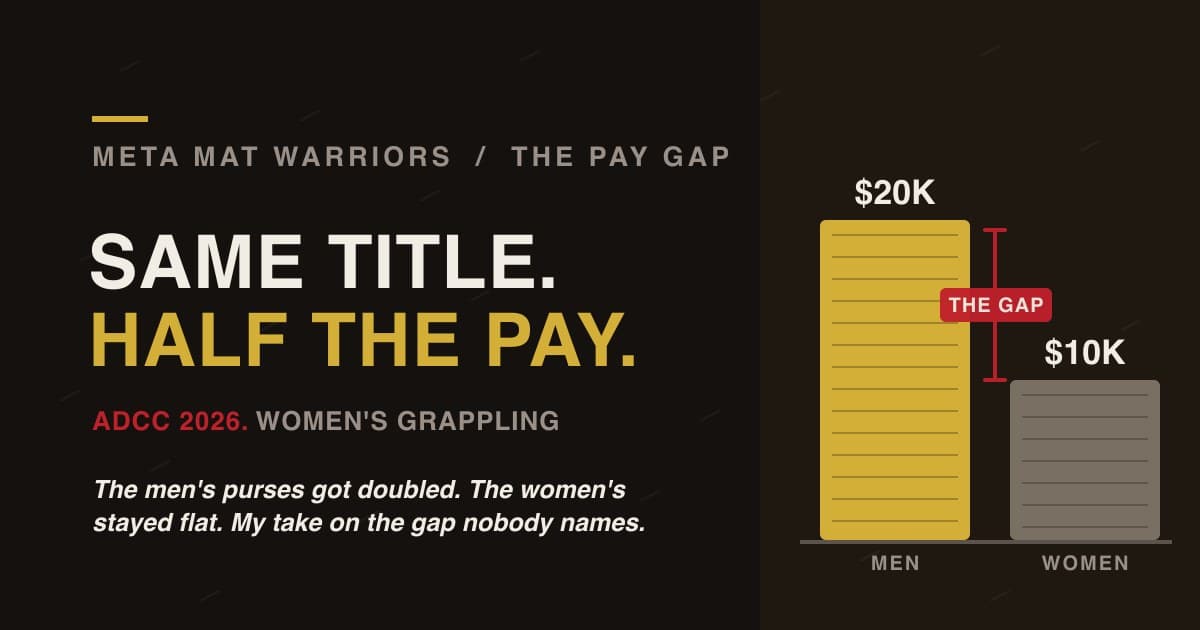
Grappling Finally Found The Money. The Women Are Still Waiting To See Their Share Of It
ADCC doubled the men's prize money for 2026 and left the women's purses exactly where they were, so a male champion now earns twice what a female champion does for winning the same world title. Craig Jones offered to cover the gap out of his own pocket, the women's absolute quietly disappeared, and Mayssa Bastos punched her ticket to Kraków anyway. Here is my honest take on the pay gap nobody in grappling wants to talk about.
UFC BJJ Is Quietly Becoming the Most Important Grappling Promotion. Here's My Take.
Six events in, UFC BJJ has gone from curiosity to the most consistent paycheck in pro grappling. What the format actually is, why the Opens divisions are the smart story, and whether this finally fixes the sport's money problem. Field opinions throughout.