The State of BJJ in 2026: What's Actually Trending on the Mats
Sub-only is eating the pro scene, body lock passing is the new answer to leg locks, and gym fees have crossed into Equinox territory. A field report on where Brazilian Jiu-Jitsu actually is in May 2026, with opinions.
A year ago you could still argue IBJJF points-based grappling was the centre of gravity in BJJ. That argument is dead. Sub-only is winning the eyeballs, the prize money, and the YouTube algorithm. The technical meta has shifted along with it. The economics of training have shifted too, and not in the direction your wallet is going to like.
Here is what the data and the gym floor are telling me right now, written from the mat in May 2026, with personal opinions throughout because anyone telling you the trends without their own take is just a content farm.
1. Sub-only is eating the pro scene
Search interest for "sub only" has roughly doubled in the past twelve months. That is not a vibe, that is Google Trends. CJI broke the format wide open in 2024, and by the time the second event landed in late 2025 the genie was not going back in the bottle. ADCC is still the crown, but everything underneath it has tilted toward submission-only or submission-weighted rules.
Why it matters: a sub-only ruleset rewards finishers and punishes stallers. Points-based grappling rewards positional control, and at the highest level that turned into long minutes of grip fighting and stalled passes. Casual viewers checked out. Sub-only gives you scrambles, real submission attempts, and a clear winner who actually beat the other guy.
My take: this is good for the sport as a spectator product and slightly bad for the technical depth of the average competitor. The kid who only ever trains for EBI overtime gets a thin top game. The kid who only ever trains points gets boring to watch. You want both, and the gyms producing the next generation of pros have figured that out. The hobbyist gym usually has not.
2. The CJI free-watch model broke the paywall
For twenty years the pro grappling business model was "lock the matches behind a $30 PPV and pray." CJI streamed the whole thing for free on YouTube and made up the money on prize purses, sponsorship and downstream attention. It worked. Now everyone is scrambling.
Even FloGrappling has been forced to open more matches. The genie here is the same genie that hit boxing twenty years ago when you could suddenly watch a fight on a phone. Once the audience knows the product can be free, paying for it feels like a tax on being a fan.
My take: this is the single biggest structural change in BJJ media since the sport went online. Long term it is going to consolidate the pro scene into two or three viable platforms. The athletes win. The middlemen lose.
3. Leg locks are baseline. Body lock passing is the answer.
Five years ago the leg lock revolution was the story. Today it is the floor. If you are a brown belt and you cannot defend a saddle entry, that is a hole in your game, not an excuse. Everyone has the heel hook. The interesting question is what passes the guards that the leg lockers built to set them up.
The answer that has emerged at the top level is body lock passing. Heavy, pressure-first, hip-to-hip, with the head and arm staple as the finishing position. It is unflashy and it works because it removes the leg entanglements before they start. Tye Ruotolo runs it. Roosevelt Sonnenberg runs a version of it. Even Gordon's game has tilted that way.
My take: if you are a hobbyist trying to pick where to invest the next year of your training, body lock passing is a better bet than a new guard. It is universal, it works in gi and no-gi, and it does not get neutralised by the next ruleset change.
4. Wrestling base is now the price of admission
The crossover from elite wrestling into pro grappling is no longer a novelty. The takedown game at the top level looks like a wrestling tournament. The Dagestani-style chain wrestling, the snap-down to front headlock, the underhook game that ties up into a body lock pass: this is the meta now.
A pure guard player at world-class level does not exist anymore. Even the historical guard specialists have all added a competent takedown game. If you are starting BJJ in 2026 and your gym does not drill takedowns at least once a week, find a different gym, or supplement with a wrestling class. This is no longer optional.
My take: this is a healthy correction. The old "everyone pulls guard" culture made BJJ a worse martial art than it needed to be. Watching the new wave of athletes wrestle, scramble, and finish on the ground is closer to what jiu-jitsu was supposed to be.
5. AI film review is finally useful
Two years ago the BJJ film review apps were a meme. The auto-tagging was wrong, the search was useless, and most people just gave up. In 2026 the tools have crossed the line into actually useful. You can film a five-minute round on your phone, upload it, and get back a timeline that correctly tags your passes, sweeps, submission attempts and time spent in each position. Some of them even flag the moments you tapped to specific submissions.
I have been using one for about three months. It is not perfect. It still confuses half guard for closed guard about a third of the time. But the search is good enough that I can pull up every time someone caught me in a specific position over the last quarter and watch it back to one clip. That is a different kind of training intelligence than my coach can give me, because my coach was not in every roll I had.
My take: this is the first piece of new training technology since the GoPro that is actually going to change how serious hobbyists improve. Not by replacing coaches but by giving you the raw material to be honest with yourself. See our BJJ mental and physical conditioning guide for where film review fits in the broader training stack.
6. Gym fees are now Equinox-tier in major cities
The other shift nobody loves talking about: BJJ has gotten expensive. A standard adult membership at a respected gym in London, New York, LA or Austin is now $200 to $300 a month, sometimes more. Privates have crept past $200 an hour. Comp team contributions are extra. Seminars are $150 a head.
Some of this is rent inflation. Some of it is the influx of office workers who got into the sport during the Joe Rogan boom and pay without flinching. Some of it is gyms finally charging what their product is worth. But the math has changed for the working hobbyist. If you train at a top gym in a top city you are spending more on BJJ than you are on the gym, your gas bill and your streaming services combined.
My take: this is going to fork the sport. The good news is the smaller community gyms, the garage operations and the open mat networks are stronger than they have ever been. If your local gym charges $300 and treats you like a number, find the underground spot in your city. It exists. The technical level might surprise you.
7. Women's BJJ is finally getting infrastructure
Not so long ago the women's brackets at major tournaments were thin and the divisions were stitched together. That has changed faster than I expected. Most decent gyms now run a women's class or an open-to-all class with real coaching for women instead of a token slot. Pro events are running full women's brackets and paying actual money. The talent pool is deeper than at any point in the sport's history.
There is still a long way to go. Pay parity is not real yet, sponsor money is uneven, and the gym culture problem has not been universally solved. But the trajectory is right. If you coach, run a gym, or organise events, this is the single highest-leverage place to invest the next twelve months.
My take: the people calling this a fad five years ago are quiet now. Read our notes on rolling with men as a woman in BJJ for the on-the-mats perspective from someone living it.
8. The gear market is cooling
The pandemic-era boom in BJJ gear brands has hit its hangover. A bunch of the smaller premium gi brands have either folded or merged. The mid-tier is consolidating around three or four reliable names. The boutique rash guard scene that exploded between 2021 and 2024 is much quieter. Patches are out, clean designs are in.
The practical implication for buyers: there has never been a better time to pick up a good gi for under $150. Inventory is plentiful, brands are competing on price, and the QC on the mid-tier stuff has crept up. Read our best BJJ gis guide and Hayabusa rashguard review for what is actually worth your money right now.
My take: stop chasing limited drops and buy gear that lasts. The amount of money a hobbyist wastes on a new gi every six months because the last one was a "good investment" is its own niche economy.
What I am personally watching for the rest of 2026
A few specific bets:
- ADCC 2026 is going to set the technical tone for the next two years. Whoever wins absolute is going to define what the model competitor looks like. If I had to bet right now I would bet on someone with a heavy body lock pass and a wrestling base. The pure leg locker era is closing.
- CJI 3 if it lands is going to test whether the free-to-watch model is repeatable or whether it was a one-off because Craig Jones could subsidise it. The format is still evolving.
- Gym-to-pro pipelines are getting more formal. New Wave is no longer the only structured pro team. Expect at least two more recognisable teams with full coaching, S&C, video review and travel budgets by year end. See our New Wave Jiu-Jitsu writeup for the template.
- A real BJJ rankings system that the average fan can follow. The IBJJF ranking is opaque. The fan-facing alternatives are getting better. Our own IBJJF athlete rankings is one attempt at this.
The bottom line
BJJ in 2026 is more watchable, more expensive, more technical, and more honest about what works than it has ever been. The pro scene is finally a real spectator product. The amateur scene is more accessible if you pick the right gym and more punishing if you pick the wrong one. The technical meta has stabilised around pressure passing and wrestling-led entries, and the next leap is going to come from training tech, not new techniques.
The thing that has not changed: the only grapplers who actually get good are the ones who keep showing up. None of these trends matter if you are not on the mats five times a week, drilling the boring stuff and rolling with people who beat you up.
Get back on the mats. The sport has not been this interesting in a long time.
Filed under Community
// Keep going
More from Community
The Buggy Choke Is The Move Everyone Loves To Hate, And They Are All Wrong About It
The buggy choke is the submission that splits every gym in two. Half the room calls it a disrespectful white belt gimmick, the other half is busy tapping people with it from the bottom of side control. Kade Ruotolo finished it on the biggest stages in grappling, the IBJJF still has not banned it, and TikTok cannot stop showing it to you. Here is my honest take on why both camps have it wrong, and the one warning nobody attaches to it.
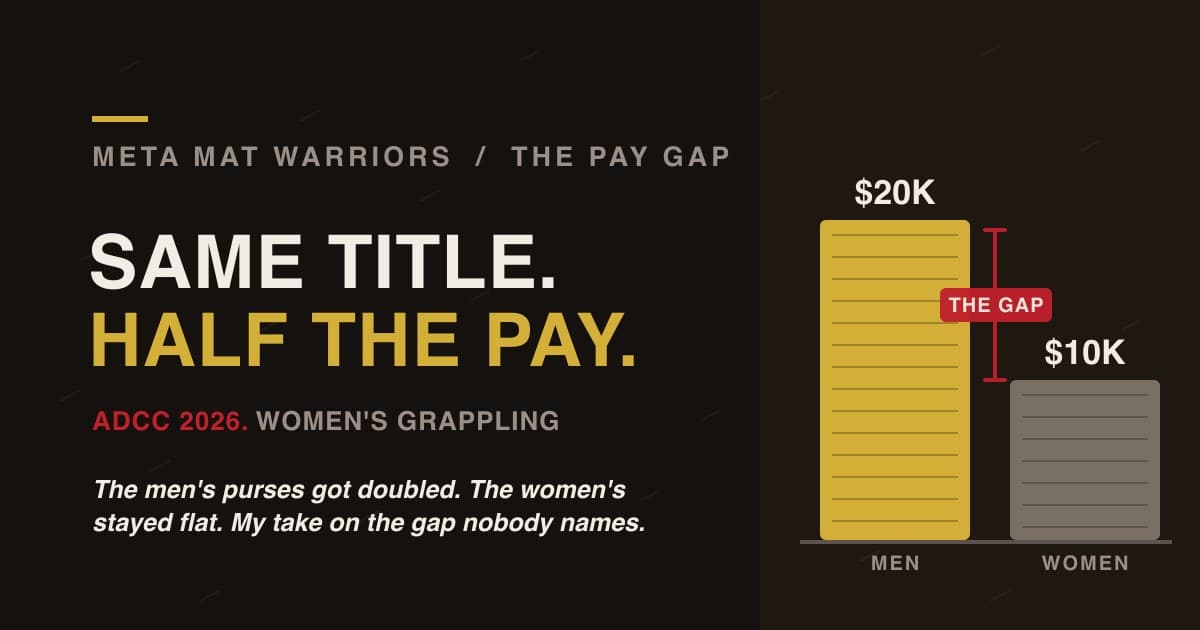
Grappling Finally Found The Money. The Women Are Still Waiting To See Their Share Of It
ADCC doubled the men's prize money for 2026 and left the women's purses exactly where they were, so a male champion now earns twice what a female champion does for winning the same world title. Craig Jones offered to cover the gap out of his own pocket, the women's absolute quietly disappeared, and Mayssa Bastos punched her ticket to Kraków anyway. Here is my honest take on the pay gap nobody in grappling wants to talk about.
CJI 2.5 And The $10 Million Bomb Craig Jones Just Dropped On Pro Grappling
Craig Jones announced CJI 2.5 with a $10,000,000 prize pool last week and the BJJ internet has not shut up since. What the number actually buys, who it pressures, and why I think it is both the best and the most reckless thing to happen to the sport in a decade.