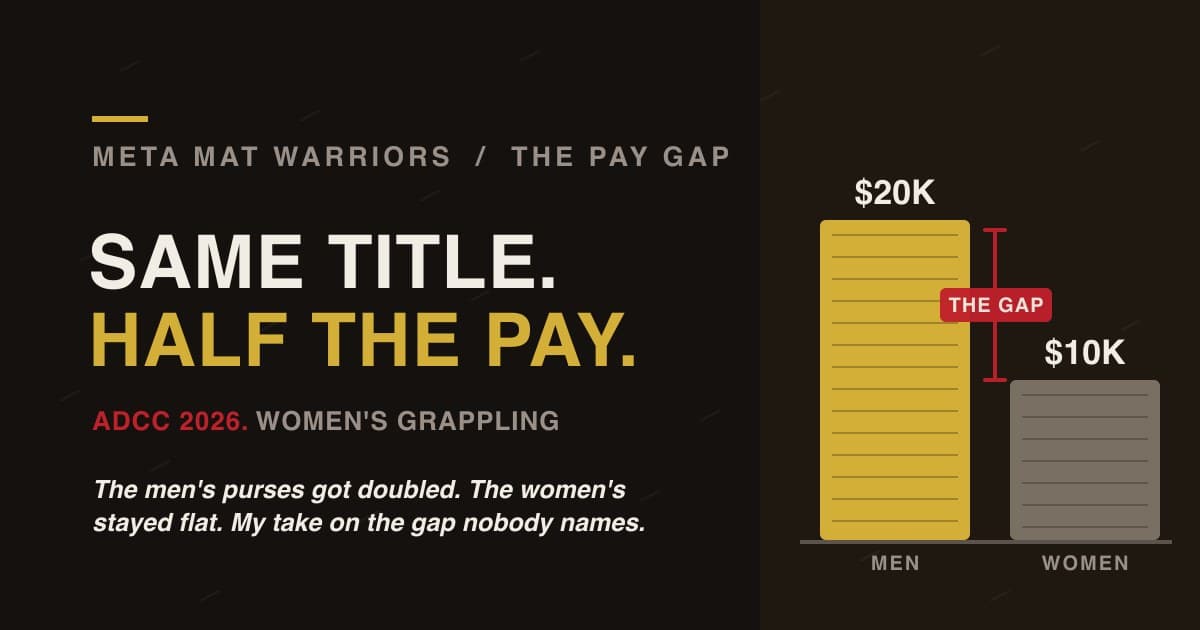
Grappling Finally Found The Money. The Women Are Still Waiting To See Their Share Of It
ADCC doubled the men's prize money for 2026 and left the women's purses exactly where they were, so a male champion now earns twice what a female champion does for winning the same world title. Craig Jones offered to cover the gap out of his own pocket, the women's absolute quietly disappeared, and Mayssa Bastos punched her ticket to Kraków anyway. Here is my honest take on the pay gap nobody in grappling wants to talk about.
I have spent the better part of this year writing about grappling finally getting paid. The UFC built a whole promotion around it, Craig Jones dropped a ten million dollar prize pool on the sport, and even retired fighters are choosing the mat over the cage because there is now a living in it. That story is real and I stand by every word of it. But there is a part of the same story I have been quieter about than I should have been, and the ADCC 2026 prize money breakdown dragged it back into the light. The money arrived. It just did not arrive evenly.
Here is the part that stopped me. For the ADCC World Championship this year, the organisation doubled the men's prizes. A male division winner now takes home twenty thousand dollars, with ten thousand for silver and three thousand for bronze. Good. That is the sport maturing, that is the kind of number that lets a grappler treat this as a career instead of a hobby with a GoFundMe attached. Then you look across the page at the women's divisions and the gold medal pays ten thousand. Silver pays five. Bronze pays two. Those numbers did not move. They are the same figures from the previous edition, sitting right next to a men's column that just got doubled.
Same world title, half the cheque
I want to be precise about what that means, because it is easy to wave away with a percentage and a shrug. A woman who wins the ADCC world championship, the single most prestigious title in submission grappling, the thing that takes a decade of full time training and a brutal trials gauntlet to even qualify for, gets handed half of what the man one bracket over gets for the identical achievement. Sixteen thousand dollars of difference per division, across three women's weight classes. Add it up and the gap is forty eight thousand dollars between what the men's side and the women's side are paid to crown champions on the same night, in the same arena, on the same broadcast.
That is not a rounding error. That is a decision. Somebody at ADCC looked at the budget, decided the men's purses needed doubling to stay competitive with what Craig Jones is paying, and decided the women's purses were fine as they were. The women drew the same crowd, fought on the same card, and bled on the same mat. They just got told their half of the event was worth keeping flat.
Craig Jones offered to pay the gap himself, and that says plenty
The detail that really lands is who stepped in. Craig Jones, through his Fair Fight Foundation, publicly offered to cover the entire forty eight thousand dollar difference out of his own pocket so the women would be paid the same as the men. His line, and I am quoting it because it is too good not to, was that he would do it "out of the kindness of my own heart and the Fair Fight Foundation to pay the difference so that women and men get paid the same for ADCC."
Now, Craig is a showman and a wind up merchant and half of what he does is a shot at the establishment that he loves to needle. The CJI exists in large part to embarrass the old guard into moving faster. I get all of that. But strip the theatre away and the substance is uncomfortable: the gap was small enough that one competitor could close it with a personal cheque, and the governing body still chose not to. When the fix costs less than a mid level athlete's appearance fee and the sport's biggest disruptor is the one volunteering to write it, the people in charge do not get to call the gap an unfortunate financial reality.
It got messier from there. Jones later pulled the offer over a separate dispute about who ADCC was keeping on the card, which turned the whole thing into another chapter of the running feud between him and the ADCC camp. Gordon Ryan, never one to let a Craig Jones talking point go unanswered, jumped in to argue that ADCC actually pays women better than CJI does on a percentage basis. Maybe the percentages work out in ADCC's favour if you squint at them the right way. It does not change the thing a female world champion actually experiences, which is looking at her bank transfer and seeing half of what the bloke next to her got.
The women's absolute disappeared and nobody announced it
While everyone was arguing about purses, ADCC quietly removed the women's absolute division from the 2026 championship. No press release, no explanation, it just stopped appearing. The absolute, the open weight bracket where anyone can enter and the best grappler regardless of size gets to prove it, is one of the most prestigious things you can win in this sport. The men still have theirs. The women's one vanished into the footnotes.
I keep coming back to that because it is the quieter tell. Cutting prize money growth is a budget choice you can at least pretend is about finances. Cutting an entire division is a statement about how much you think the women's side is worth promoting. Fewer brackets means fewer opportunities, fewer marquee matchups, fewer reasons for a sponsor to invest in a female athlete's career. It is the kind of decision that compounds, and it is exactly the sort of thing the sport said it was leaving behind when the money started flowing in.
The talent is right there, which makes it worse
The frustrating part is that the women's product does not need a charity case argument. It needs the same investment the men just got. Look at what is actually happening on the mat. Mayssa Bastos just won the second ADCC South American Trials and booked her spot in Kraków, and she did it the hard way, going through four matches without surrendering a single point. She is twenty eight, she has ten IBJJF world titles, and she is one of the most technically complete grapplers of either gender competing right now. That is a headline act. That is someone you build a card around.
She is not alone. The depth in the women's divisions is the best it has ever been, and I have written before about how much the women's side of the sport has grown, from the athletes to the size of the talent pool to names like Danielle Kelly carrying titles in the bigger promotions. The audience shows up for it. The CJI even made its viewership numbers public and the women's matches pulled comparable eyes to the men's finals, which is the single most useful data point in this entire argument because it kills the lazy excuse that nobody watches the women. People watch. The numbers say so.
Where I actually land
I am not interested in turning a grappling blog into a lecture, and I am wary of pretending a combat sport pay gap is the most important injustice in the world. It is not. But I write about where this sport is going, and I have spent a year cheering the fact that it is finally going somewhere with real money behind it. If I am going to celebrate the cheques getting bigger, I have to be honest about who is getting the smaller ones.
The fix here is not complicated and it is not even expensive. Pay the women's champions what the men's champions get. Put the women's absolute back. Treat the depth in those divisions as the asset it obviously is instead of the part of the card you trim when the budget gets tight. ADCC is the most important event in the entire grappling calendar, and how it handles this sets the standard everyone else copies. When the sport was broke, paying everyone badly was at least consistent. Now that the money is here, paying half the champions half as much is just a choice, and it is the wrong one.
The women will be in Kraków in September either way. They qualified through the same trials, they will fight the same nine minute matches, and they will earn every cent they are handed and then some. The least the sport can do, now that it can finally afford to, is hand them the same amount.
Quick answers
How much does ADCC pay women compared to men in 2026? A men's division champion earns twenty thousand dollars for 2026, with ten thousand for silver and three thousand for bronze. A women's division champion earns ten thousand, with five thousand for silver and two thousand for bronze. The men's purses were doubled this cycle while the women's stayed at their previous level.
What is the total ADCC prize money gap between men and women? Roughly forty eight thousand dollars, made up of a sixteen thousand dollar gap per division across three women's weight classes.
Did Craig Jones offer to pay the difference? Yes. Through his Fair Fight Foundation he publicly offered to cover the full forty eight thousand dollar gap so women and men would be paid equally at ADCC, before later withdrawing the offer over a separate dispute with the organisation.
Did ADCC remove the women's absolute division? Yes. The women's open weight absolute division was dropped from the 2026 ADCC World Championship without a formal announcement, while the men's absolute remained on the card.
Who is Mayssa Bastos? She is a Brazilian grappler, twenty eight years old, with ten IBJJF world titles. She won the second ADCC South American Trials in 2026 without conceding a point to qualify for the ADCC World Championship in Kraków.
When and where is ADCC 2026? The ADCC World Championship 2026 takes place at the Tauron Arena in Kraków, Poland, on the twelfth and thirteenth of September 2026. Our full preview of the event breaks down the brackets and the favourites.
Filed under Community
// Keep going
More from Community
The Buggy Choke Is The Move Everyone Loves To Hate, And They Are All Wrong About It
The buggy choke is the submission that splits every gym in two. Half the room calls it a disrespectful white belt gimmick, the other half is busy tapping people with it from the bottom of side control. Kade Ruotolo finished it on the biggest stages in grappling, the IBJJF still has not banned it, and TikTok cannot stop showing it to you. Here is my honest take on why both camps have it wrong, and the one warning nobody attaches to it.
CJI 2.5 And The $10 Million Bomb Craig Jones Just Dropped On Pro Grappling
Craig Jones announced CJI 2.5 with a $10,000,000 prize pool last week and the BJJ internet has not shut up since. What the number actually buys, who it pressures, and why I think it is both the best and the most reckless thing to happen to the sport in a decade.
UFC BJJ Is Quietly Becoming the Most Important Grappling Promotion. Here's My Take.
Six events in, UFC BJJ has gone from curiosity to the most consistent paycheck in pro grappling. What the format actually is, why the Opens divisions are the smart story, and whether this finally fixes the sport's money problem. Field opinions throughout.