UFC BJJ Is Quietly Becoming the Most Important Grappling Promotion. Here's My Take.
Six events in, UFC BJJ has gone from curiosity to the most consistent paycheck in pro grappling. What the format actually is, why the Opens divisions are the smart story, and whether this finally fixes the sport's money problem. Field opinions throughout.
For twenty years pro grappling has had a money problem. The athletes were world class and the audience was rabid. The paydays were not. Most of the best grapplers on the planet were running seminars on weekends to pay rent while their boxing and MMA counterparts in similar weight classes were buying houses.
That math has started to shift, and the engine of the shift is something I would not have predicted two years ago: the UFC has its own grappling league now. UFC BJJ 6 just landed and the rising search interest around the promotion is louder than anything else in the sport this quarter. Capsule lock and a few rules-meta queries are spiking, sure, but UFC BJJ is the structural story.
Here is what the promotion actually is, where the format is interesting, where it is not, and what I think it means for the next two years on the mats. Opinions throughout, because anyone reporting "the trends" without their own take is just a content farm trying to rank.
What UFC BJJ actually is
UFC BJJ is the UFC's submission-grappling league. Different brand, same machine. TKO money, UFC production, UFC announcers, UFC PR, a card structure that looks like a fight night. Matches are sub-only with overtime, scored fights have a clear bias toward finish attempts, and the events run roughly monthly under the UFC fight pass umbrella.
That is the boring summary. The interesting part is the structure of the cards. Every event has a main card of contracted athletes in established weight classes, and underneath that an "Opens" bracket where anyone with a credible record can apply, qualify, and compete for cash. The Opens are the pipeline. You win your bracket, you get noticed, you get a contract offer, you move to the main card. It is the same model the UFC used in the late nineties when they signed everyone from the regional circuit who could win in their backyard.
For a sport whose previous pipeline was "win ADCC trials, hope someone notices, run a seminar tour," that is a real structural change.
The Opens are the actually interesting story
Most of the press around UFC BJJ has been about the main card signings. Gordon, the Ruotolos, Mikey, the New Wave guys, the obvious names. That is the headline. But if you are paying attention to the sport as a working hobbyist, the Opens are where the actual interesting thing is happening.
A purple or brown belt with a serious local record can now enter a UFC BJJ Open, win three matches in an afternoon, and walk away with prize money, real video footage, and a credible inbound from a real promotion. That did not exist a year ago. The equivalent path used to be: place top three at IBJJF Pans, hope a sponsor calls, take an unpaid invite to a small show, hope someone in your weight class no-shows so you get a bump up the card.
My take: the Opens are going to produce the next generation of pro grapplers faster than any feeder system the sport has ever had. We are already seeing names emerge from the regional brackets that I had genuinely never heard of, who could clearly hang at the highest level. The talent was always there. The discovery mechanism was the bottleneck.
The money question
Look, I do not have everyone's contracts. Nobody does. But the publicly reported numbers and the gossip from gyms that have placed people on the cards put the floor for a main card win at multiples of what a top three IBJJF finish pays, and the marketing bonuses for finishes are real.
For a working pro this is the first stable model that lets you train full time without running a seminar circuit. CJI proved the headline number could exist for the top five guys. UFC BJJ is the first thing that has paid the guys at positions six through forty. That is the part that matters for the depth of the sport.
My take: this is a bigger deal than CJI even though CJI got the bigger headlines. CJI was a single event with a once-a-year purse. UFC BJJ is a salary. The first is fireworks. The second is infrastructure.
What I do not love about it
I am not going to pretend this is all upside. A few things have already started bothering me.
The points-versus-finish balance is not settled. The rules have been tinkered with between every event. Event two looked like a sub hunt. Event four felt like the judges were punishing the more active grappler in two of the main card splits. By event six it has stabilised a bit, but a young promotion shifting the scoring math under athletes' feet is not a great look. CJI had the same issue early. ADCC has had it forever. It is the curse of the sport, and a fix would be worth real money to whoever lands it first.
The production gloss is hiding some thin storytelling. UFC BJJ events are beautifully shot. But the announcers are still feeling out how to talk about grappling for a UFC-trained audience and the prefight packages keep selling the wrong fights. The lay viewer watching their first event still has trouble figuring out which guard pass is the technical apex of the match. This is fixable. CJI did it by leaning into Craig's commentary. UFC BJJ will get there once they figure out which commentators actually speak the language.
The contract structure is still tilted. Standard contract terms in any combat sport favour the promoter, and the early UFC BJJ paperwork looks roughly as tilted as the early UFC fight contracts did. The athletes who signed in the first wave of UFC BJJ deals are stuck with them for a while. I expect a free agency story to break by the end of 2026 once one of the bigger names hits the end of their initial contract and goes public on what they were paid versus what they actually pulled in eyeballs.
How it actually changes the technical meta
Three knock-on effects I have already noticed on the gym floor.
First, more people are taking takedowns seriously. UFC BJJ rewards starting standing, the sub-only scoring rewards getting to a finishing position fast, and the gap between a guard puller and a wrestler in those rulesets is brutal to watch. I wrote about wrestling base as the price of admission in the state of BJJ in 2026 piece and UFC BJJ is the single biggest accelerant of that trend. Gyms that did not drill takedowns are suddenly drilling takedowns.
Second, body lock passing is everywhere on UFC BJJ cards. The ruleset penalises stalled positions, the time pressure is real, and the most efficient way to remove leg entanglements before they start is heavy pressure passing from a body lock. If you are a hobbyist looking for the highest leverage passing system to learn right now, watch any UFC BJJ event from the last three and count the body locks per round. It is not subtle.
Third, the leg lock game has matured into a defence-first conversation. Five years ago you could win matches by being the only person in the round who knew the heel hook entries. Today every UFC BJJ contracted athlete defends the saddle in their sleep. The interesting attacks at the top level are the variants people have not solved yet, which is partly why niche stuff like capsule lock entries have spiked in search this month. The game has not stopped evolving. It has stopped having free wins.
What this means for athletes outside the UFC BJJ system
The hardest question in the sport right now is whether ADCC, IBJJF, CJI and the smaller pro promotions can coexist with a UFC-backed monthly grappling league that pays. I think most of them can, but not all.
ADCC is safe because it is the crown and the four year cycle gives it a different meaning. The next ADCC is going to look like a UFC BJJ alumni reunion at this rate, and that is fine. The two events do different things.
IBJJF is going to be fine for the gi side and the lower belts but the upper black belt brackets at the major IBJJF events are going to thin out. Why would you train year round to win Worlds for prestige and a small purse when you can win three UFC BJJ Opens for real money and a contract path? Some athletes will still do both. The structural pull is one direction.
CJI is the interesting one. CJI proved the free-to-watch model. UFC BJJ has the same free-on-Fight-Pass instinct in places and is much better capitalised. If CJI keeps its annual cadence and lets UFC BJJ run the monthly drumbeat, both can win. If CJI tries to compete on volume it is going to get squeezed.
My take: the smart pro grappler in 2026 is treating UFC BJJ as their salary, ADCC as their prestige, CJI as their lottery ticket, and IBJJF as their off-season tune up. The grappling calendar finally looks like a real combat sport calendar.
What I am personally watching for the rest of 2026
A few things to track over the next two quarters.
- UFC BJJ 7 main event. Whoever they put in the marquee slot tells you which weight class the promotion thinks is going to drive the next quarter of subscription numbers. My bet is they go heavy on the lightweight division because the talent depth is absurd. See our top BJJ athletes writeup for the names to watch.
- The first big New Wave contract. New Wave has dominated the technical conversation in BJJ for years. They are also the team most likely to negotiate hard on terms because they have the leverage. Watch our New Wave Jiu-Jitsu writeup for the team's structure and why their bargaining position is unusually strong.
- A women's UFC BJJ marquee. The women's divisions have been treated as undercard so far. That is going to change because the talent is there and the promotion knows it. Whoever they build as the first women's headliner is going to set the template for women's grappling pay for the next five years.
- The first Open-to-main-card success story. Someone is going to climb out of the Opens onto a contract, win a main card match, and become the face of the path. That story sells the next thousand Open entries.
- Whether Gordon Ryan shows up. He has had health issues. He has also got the highest individual marketability in the sport. UFC BJJ pulling him in for even one match would be the biggest event the promotion has run.
The bottom line
UFC BJJ is the most important structural thing that has happened to pro grappling in twenty years. Not because the matches are better than CJI or the prestige is higher than ADCC, but because it is the first thing in the sport that looks like a salary instead of a tournament. The athletes have wanted this for a generation. The fans wanted it the moment the first ADCC went on PPV and made about four people rich. The infrastructure is finally here.
The downside risk is real. The contracts are tilted, the scoring is still moving, the storytelling is thin in places. But the direction is right. If you train, if you watch, if you care about whether the next generation of grapplers can afford to be full time, this is the thing to pay attention to.
The sport spent two decades being the most technically advanced combat art with the worst business model. That tradeoff is starting to break. The good guys are starting to get paid. The cards are landing more or less on schedule. The talent pipeline finally has a way in that does not depend on knowing the right person at the right gym in the right city.
Now get back on the mats. If you can win three rounds against a hard purple belt at your gym you can apply for an Open. The path is real for the first time. Use it.
For where the broader trends sit, see our state of BJJ in 2026 piece. For where the technical meta is heading and how to train for it, the mental and physical conditioning guide covers the work that actually moves the needle.
Filed under Community
// Keep going
More from Community
The Buggy Choke Is The Move Everyone Loves To Hate, And They Are All Wrong About It
The buggy choke is the submission that splits every gym in two. Half the room calls it a disrespectful white belt gimmick, the other half is busy tapping people with it from the bottom of side control. Kade Ruotolo finished it on the biggest stages in grappling, the IBJJF still has not banned it, and TikTok cannot stop showing it to you. Here is my honest take on why both camps have it wrong, and the one warning nobody attaches to it.
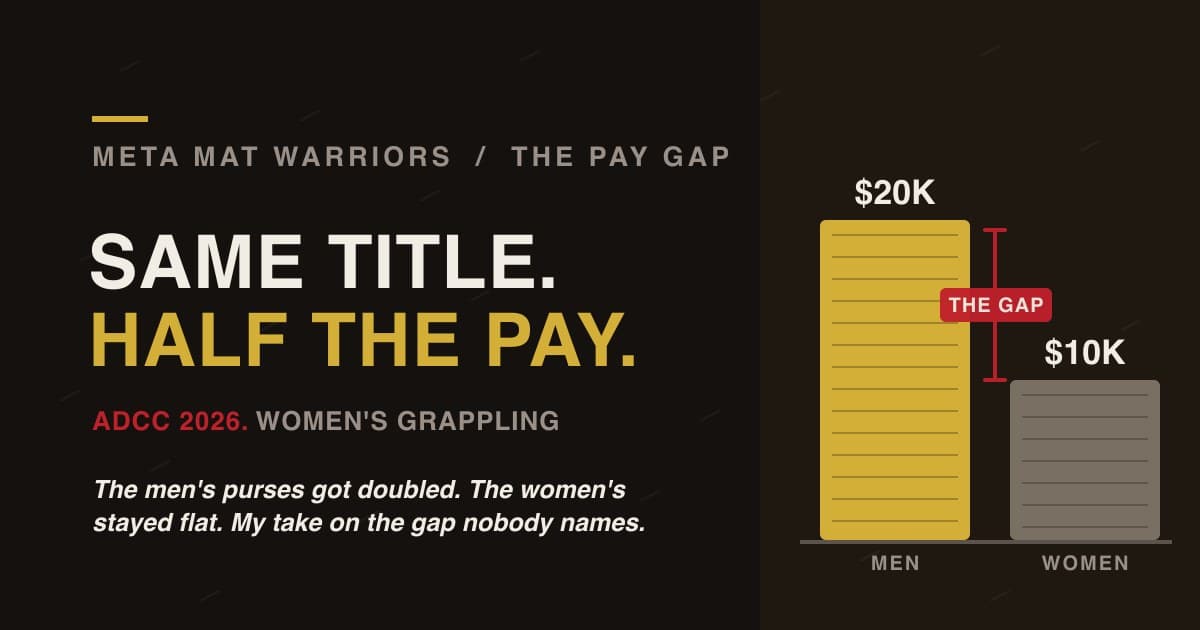
Grappling Finally Found The Money. The Women Are Still Waiting To See Their Share Of It
ADCC doubled the men's prize money for 2026 and left the women's purses exactly where they were, so a male champion now earns twice what a female champion does for winning the same world title. Craig Jones offered to cover the gap out of his own pocket, the women's absolute quietly disappeared, and Mayssa Bastos punched her ticket to Kraków anyway. Here is my honest take on the pay gap nobody in grappling wants to talk about.
CJI 2.5 And The $10 Million Bomb Craig Jones Just Dropped On Pro Grappling
Craig Jones announced CJI 2.5 with a $10,000,000 prize pool last week and the BJJ internet has not shut up since. What the number actually buys, who it pressures, and why I think it is both the best and the most reckless thing to happen to the sport in a decade.